

MANIERA at Collectible Anouck Morlon
Text by Amelia Stevens
Photography by Vittorio Franzolini
Something of a “gut feeling,” German designer Anouck Morlon cannot quite articulate what attracts her to the matelassé technique, although she suspects its allure might be culinary. Her debut solo exhibition with MANIERA Gallery translates this bodily intuition into a delectably humorous yet impressively tasteful formal expression, the comforting plumpness of raised cushions and the sculptural drama of undulating folds evoking delicately filled, folded and crimped ravioli — a kind of “cute metaphor” for the way in which fabric, like dough, can be pinched, pleated, puckered, and gently coaxed by hand into novel shapes, forms, and topographies.
Originally enrolled in fine art at the Kunstakademie in Düsseldorf, Morlon’s appetite for applied arts and manual techniques led her to internships with BLESS and SuperYaya, and ultimately to redirect her studies toward industrial design at ÉCAL in Lausanne. There, a brief to “cover up” a wooden transat chair prompted the creation of an experimental upholstery — an antipasto, so to speak, for what would later become a more substantial piece of upholstered furniture. While she concedes that the wooden transat functioned perfectly well on its own, her idea was “to make it chic” — “and to make it chic, I needed to hide it,” she quips with tongue in cheek.
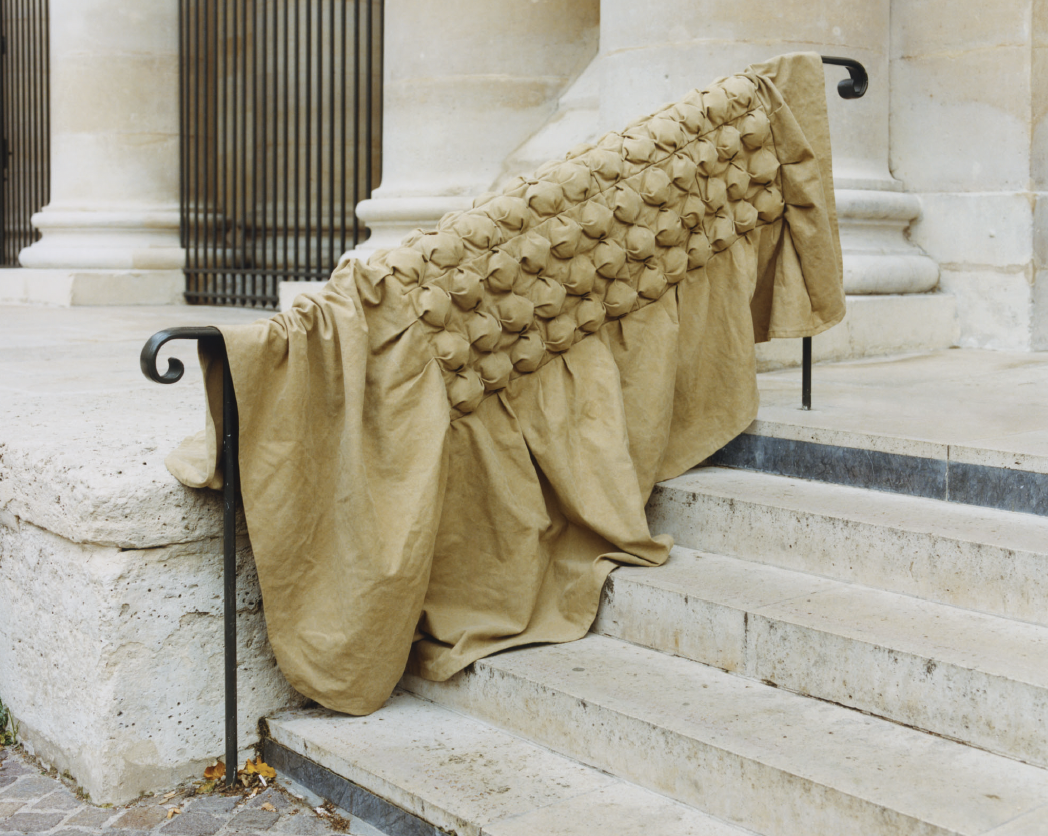
Although Morlon cites precedents from illustrious design history — most notably Eileen Gray’s elegant Fauteuil Transatlantique (1926), inspired by the deckchairs of luxury transatlantic ocean liners popular in the 1920s, designed for the terrace of her villa on the French Riviera, and later produced in leather, hair hide, and various fabrics — her own approach to upholstery is distinctly sartorial. Approaching the brief as a kind of “dressing up” of the wooden transat, her research drew on The Art of Manipulating Fabric by Colette Wolff, a comprehensive manual of gathering, pleating, shirring, smocking and tucking techniques that she first encountered during her internship with Beirut-based womenswear designer Rym Beydoun of SuperYaya. It was within these pages that she discovered the sculptural potential of matelassé. Putting this technique into practice while at ÉCAL, she transformed a papery, starched, two-dimensional fabric sourced from an oldschool fabric store in Montmartre, Paris, into a threedimensional landscape of cushiony mounds of fabric elevated from small, squared foundations (1). Arranging these modular matelassé panels into a tightly controlled middle section, she allowed the fabric along its edges to spill sumptuously in expressive folds that, she notes, move “a bit like a skirt.” The result was a study in how fabric, when manipulated by hand, could behave both architecturally and expressively.
Sharing images of the ÉCAL project online — amidst a curated feed of glorious drapes from the Villa Necchi in Milan, mouth-watering French crêpes, and whipped cream ruffles — the project’s experimental upholstery caught the eye of MANIERA’s Kwinten Lavigne, who proposed transforming it into a standalone lounge chair. Accepting the invitation, Morlon travelled to Brussels to work on its refi nement, elevating what began as a whimsical student experiment into an object of epicurean sophistication. Playfully titled Ravioli one seater (2025), the lounge chair features a softly contoured, crescent-shaped base composed of a triptych of foam densities, encased within a unifying inner lining — “a kind of underwear,” she adds halfjokingly — that conveys both a luxurious indulgence and sharp sartorial wit. Generously layered over this sumptuous base, the experimental upholstery has been carefully refined, then masterfully hand-sewn by a costumier from La Monnaie, the National Opera of Belgium in Brussels. Realised in a luxuriant cream fabric, this elevated outer upholstery celebrates the lounge chair’s sculptural topography and subtle play of contrasts at their most expressive, while the raised cushions and undulating folds of the prototypal student experiment are pushed further still — becoming even more pronounced, sculptural and skirt-like.
The exhibition brings together both the experimental upholstery produced by Morlon at ÉCAL and the Ravioli one seater developed in collaboration with MANIERA. Chameleon-like in their ability to shift and respond to context, light and materiality, the two works in turn obscure then dramatically reveal the expressive possibilities of the _matelassé _technique from which they emerge. In the hands of a designer such as Morlon, manipulation—once maligned—thus becomes a gesture of care, dexterity and transformation.
VIP & VERNISSAGE
Wednesday, March 11
13:00 to 21:00
FAIR DAYS
Thursday, March 12
12:00 to 19:00
Friday, March 13
12:00 to 19:00
Saturday, March 14
12:00 to 19:00
Sunday, March 15
12:00 to 18:00
MANIERA
Atelier — Workshop
Avenue de la Grande Tilleul 2 Dikkelindelaan
1020 Brussels
Open
By appointment
T +32 (0) 494 52 83 78
Follow us on Instagram